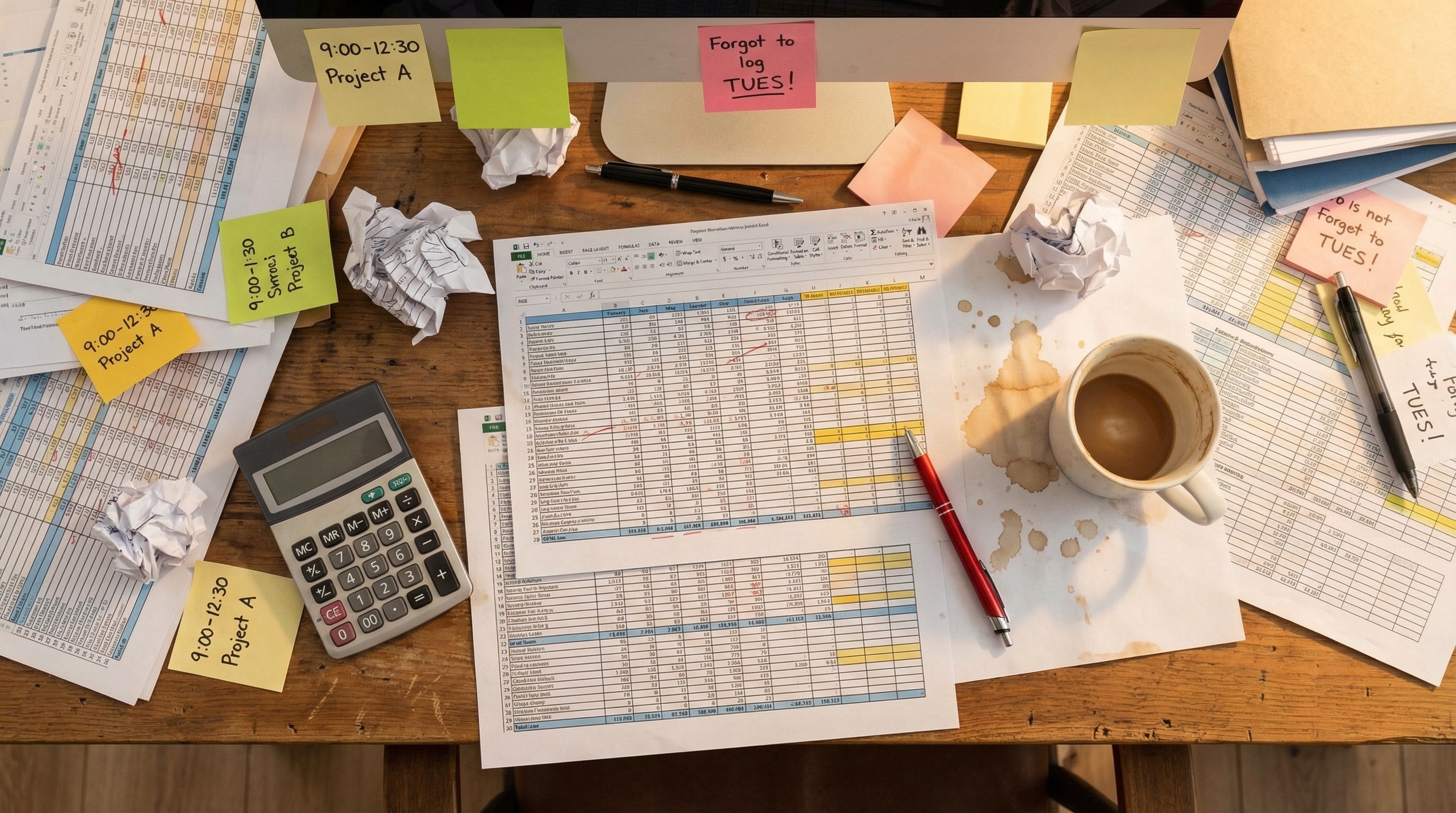
The uncomfortable truth about how most businesses track time
If you walked into a hundred European businesses today and asked how they record working hours, you would find a remarkable range of approaches. Some use shared spreadsheets on a network drive. Others rely on paper sign-in sheets taped to a wall. Many use nothing at all, relying on trust or informal agreements about when people start and stop working.
For years, this was fine. Time tracking was largely optional in most EU countries, and as long as nobody complained, nobody asked questions. But that changed in May 2019, and the implications are still catching up with employers who have not yet adapted.
What the CJEU ruling actually requires
In Case C-55/18 (CCOO v Deutsche Bank), the Court of Justice of the European Union ruled that every EU Member State must require employers to establish a system for measuring the daily working time of each employee. The court was explicit about the standard: the system must be "objective, reliable, and accessible."
These three words are not vague aspirations. They are legal criteria, and each one has direct consequences for how you track time.
- Objective: The system must record time factually, not based on subjective recall or estimates that can be adjusted to suit either party.
- Reliable: Records must be trustworthy. They need to be tamper-resistant, consistent, and verifiable over time.
- Accessible: Both employees and, where applicable, labour authorities must be able to access and review the records.
Several countries have already transposed this into national law. Spain moved fastest, making time recording mandatory for all employees in May 2019. The Netherlands followed in 2022. Denmark enacted its law in July 2024. Germany's Federal Labour Court (BAG) confirmed the obligation in a landmark 2022 ruling, and the Federal Ministry of Labour (BMAS) published a draft electronic recording law in April 2023, though it has since stalled in the legislative process.
Why spreadsheets fail every single criteria
This is where it gets uncomfortable for the many businesses still relying on Excel, Google Sheets, or similar tools. Spreadsheets were never designed for regulatory compliance, and when you measure them against the CJEU's three requirements, they fall short on all counts.
Not objective
A spreadsheet is, by its nature, a blank canvas. Anyone with access can type anything into any cell. An employee can enter whatever hours they like. A manager can adjust entries before sending them to payroll. There is no mechanism to ensure that the recorded times reflect what actually happened.
This is the opposite of objective. A system where entries can be freely fabricated, back-dated, or rounded without any verification does not produce factual records. It produces whatever the person typing wants it to say.
Not reliable
Reliability requires that records are consistent, tamper-resistant, and traceable. Spreadsheets fail this in multiple ways:
- No audit trail: When someone changes a cell in Excel, there is no automatic record of what was there before, who changed it, or when. The old value simply disappears.
- Version control nightmares: Files get copied, renamed, emailed back and forth, and saved to different locations. Within weeks, nobody knows which version is the definitive one.
- Manual errors: A misplaced decimal, a wrong date, a formula that references the wrong row. These mistakes are easy to make and hard to catch in a grid of thousands of cells.
- No data validation: A spreadsheet will happily let you enter 25 hours in a single day, negative working times, or text where a number should be. Without built-in rules, the data cannot be trusted.
Not accessible
Accessibility means employees can view their own records and authorities can inspect them when needed. Most spreadsheet-based systems fail this test badly:
- Files on local drives: If the time tracking spreadsheet lives on someone's desktop or a shared folder behind a VPN, employees working remotely or on the road have no practical way to access it.
- No mobile access: Editing a complex Excel file on a phone is technically possible but practically unusable. Employees who work in the field, in retail, or on client sites cannot reasonably be expected to do it.
- No self-service: In most spreadsheet setups, only an administrator or manager can view the consolidated data. Employees cannot easily check their own records, which violates the accessibility requirement.
Spain already considers Excel non-compliant
Spain's labour inspectorate (ITSS) has explicitly flagged spreadsheets as inadequate for meeting the country's time recording requirements. The reasoning is straightforward: because Excel files can be freely edited without leaving a trace, they do not meet the standard of objective and reliable recording. Businesses inspected in Spain that rely solely on spreadsheets have faced enforcement actions and fines of up to €225,018.
The real-world problems you already know about
Even setting aside the legal requirements, most businesses that track time in spreadsheets already live with a set of daily frustrations. If any of these sound familiar, you are not alone.
- Forgotten entries: People forget to log their hours on Friday and reconstruct the week from memory on Monday. The result is inaccurate data that nobody trusts.
- Inconsistent formats: One team uses "8:30" while another uses "8.5" and a third writes "8h30." The person consolidating the data spends hours cleaning it up before it can be used.
- Consolidation nightmares: Collecting individual files from twenty people, copying data into a master sheet, checking for errors, and generating reports. This process can consume an entire day of administrative time, every single pay period.
- No real-time visibility: A spreadsheet only tells you what has already been entered. If you need to know right now who is working on what, or whether a project is running over budget, you are out of luck.
- Error-prone calculations: Overtime, break deductions, night premiums, public holidays. Getting these formulas right in a spreadsheet is difficult. Keeping them right as rules change or new edge cases appear is nearly impossible.
These are not minor inconveniences. They cost real money in lost billable hours, administrative overhead, and payroll errors. And under the new compliance requirements, they also represent legal risk.
What a compliant system actually looks like
The good news is that the bar for compliance is not unreasonably high. The CJEU did not mandate any specific technology. It simply requires that the system meets the three criteria. In practice, that means a digital tool with a handful of essential capabilities.
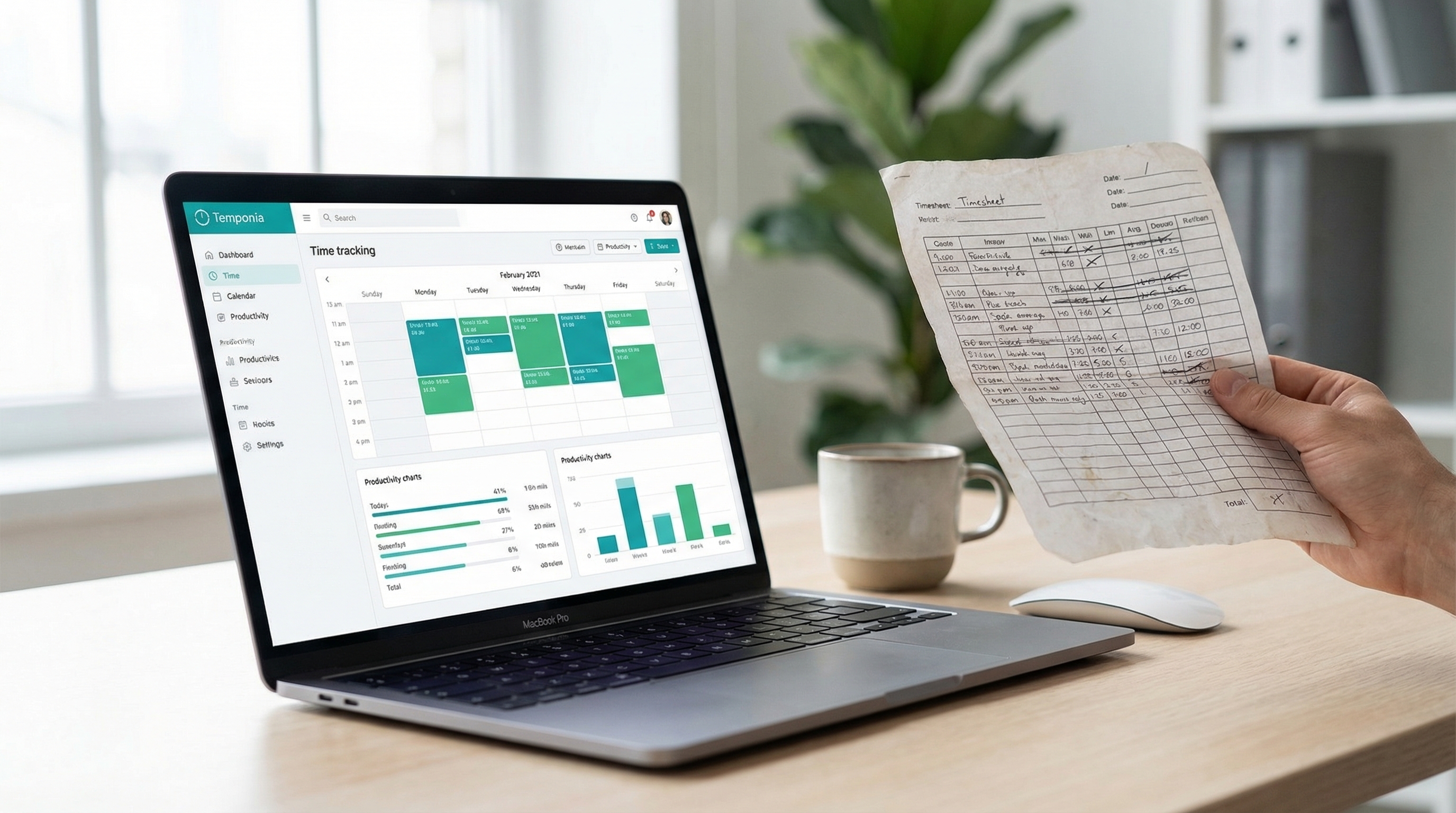
- Real-time entry: Employees log their hours as they work, not days or weeks later from memory. Timers, calendar-based interfaces, and quick-entry tools all support this.
- Tamper-proof records: Once an entry is submitted, any changes are logged with a full audit trail showing who changed what and when. The original record is preserved.
- Employee self-service: Every employee can view their own time records at any point, from any device. This satisfies the accessibility requirement and reduces questions to HR.
- Export and reporting for inspections: When a labour inspector asks for records, you need to produce them quickly and in a readable format. PDF exports, CSV downloads, and structured reports are essential.
- Mobile access: For any team that is not exclusively desk-based, mobile access is not a luxury. It is a practical necessity for capturing time accurately across all working arrangements.
The transition is easier than you think
One of the biggest reasons businesses stick with spreadsheets is inertia. The current system "works" (in the sense that it exists), and switching feels like it would be disruptive and time-consuming.
In practice, the opposite is usually true. Modern time tracking tools are designed to minimise friction. Most teams are up and running within a day, not weeks. There is no complex implementation, no IT project, no training programme that takes people away from their work.
The key is choosing a tool that fits naturally into how your team already works. If your people live in their calendars, a calendar-based interface makes the transition nearly invisible. If they are on the move, a mobile app that takes seconds to use removes the barrier entirely.
Start before the deadline
Countries across Europe are implementing the CJEU ruling at different speeds, but the direction is clear: mandatory electronic time tracking is becoming the norm. Starting now, rather than waiting for a hard deadline, gives you time to find the right fit, let your team build the habit gradually, and iron out any rough edges without the pressure of a compliance clock ticking down.
How Temponia helps
Temponia was built for exactly this scenario: businesses that need a compliant, reliable time tracking system without the overhead of enterprise software.
- Calendar-based interface: Logging time feels natural and takes seconds, so entries happen in real time rather than as a forgotten chore at the end of the week.
- Full audit trail: Every entry, edit, and deletion is logged. Records are tamper-proof and inspection-ready.
- Employee self-service: Your team can view their own records anytime, from any device.
- Mobile apps for iOS and Android: Time tracking that works wherever your team works.
- One-click exports: Generate structured reports for labour inspections, payroll, or client invoicing in seconds.
- Calendar integration: Pull in meetings from Google or Outlook calendars automatically, so nothing slips through the cracks.
If your team is currently tracking time in spreadsheets, on paper, or not at all, Temponia makes the switch straightforward. Most teams are fully onboarded within a single day.
The bottom line
Spreadsheets served their purpose when time tracking was optional and informal. That era is ending. The CJEU has set the standard, and countries across Europe are writing it into law. Spain is already enforcing it. The Netherlands, Denmark, and Germany have followed. More will come.
The question is not whether you will need to move beyond spreadsheets. It is whether you do it on your own terms, with time to choose the right tool and build good habits, or under pressure when a deadline or an inspection forces your hand.
The smart move is to start now.
Ready to replace your spreadsheets?
Switch from Excel to a compliant time tracking system in a single day. Most teams are fully onboarded within hours.