
Most CFOs do not lose sleep over time tracking itself. They lose sleep over what happens when labor cost is only visible after the damage is already done.
A large project can look healthy on paper for months. Revenue is on track, utilization looks acceptable, and the delivery team says things are under control. Then finance closes the period and discovers a different story: senior people spent far more time than planned, non-billable effort quietly expanded, margin slipped, and nobody can say exactly when it happened.
That is the real finance case for precise time tracking.
Done properly, time tracking is not an administrative ritual. It is the operating data set that lets finance connect labor hours to delivery outcomes, client profitability, and forecasting quality. Without it, project accounting tends to rely on averages, assumptions, and hindsight. With it, labor becomes measurable, comparable, and manageable.
Why profitability usually drifts before anyone notices
On large projects, margin erosion rarely comes from one dramatic event. It is usually the accumulation of small decisions that never show up clearly enough in the numbers:
- Senior specialists stepping into delivery work that was budgeted at a lower rate
- Project managers spending increasing time on coordination, recovery, and stakeholder alignment
- Internal meetings and rework being logged too late, too broadly, or not at all
- Hours being assigned to generic buckets, making the real cost drivers impossible to isolate
- Teams continuing to burn time on low-value work because nobody has a clean signal to stop
When labor is your biggest cost line, these patterns matter more than most CFO dashboards admit. If you only review project profitability at invoice time or month-end, you are already looking in the rear-view mirror.
What precise time tracking changes for finance
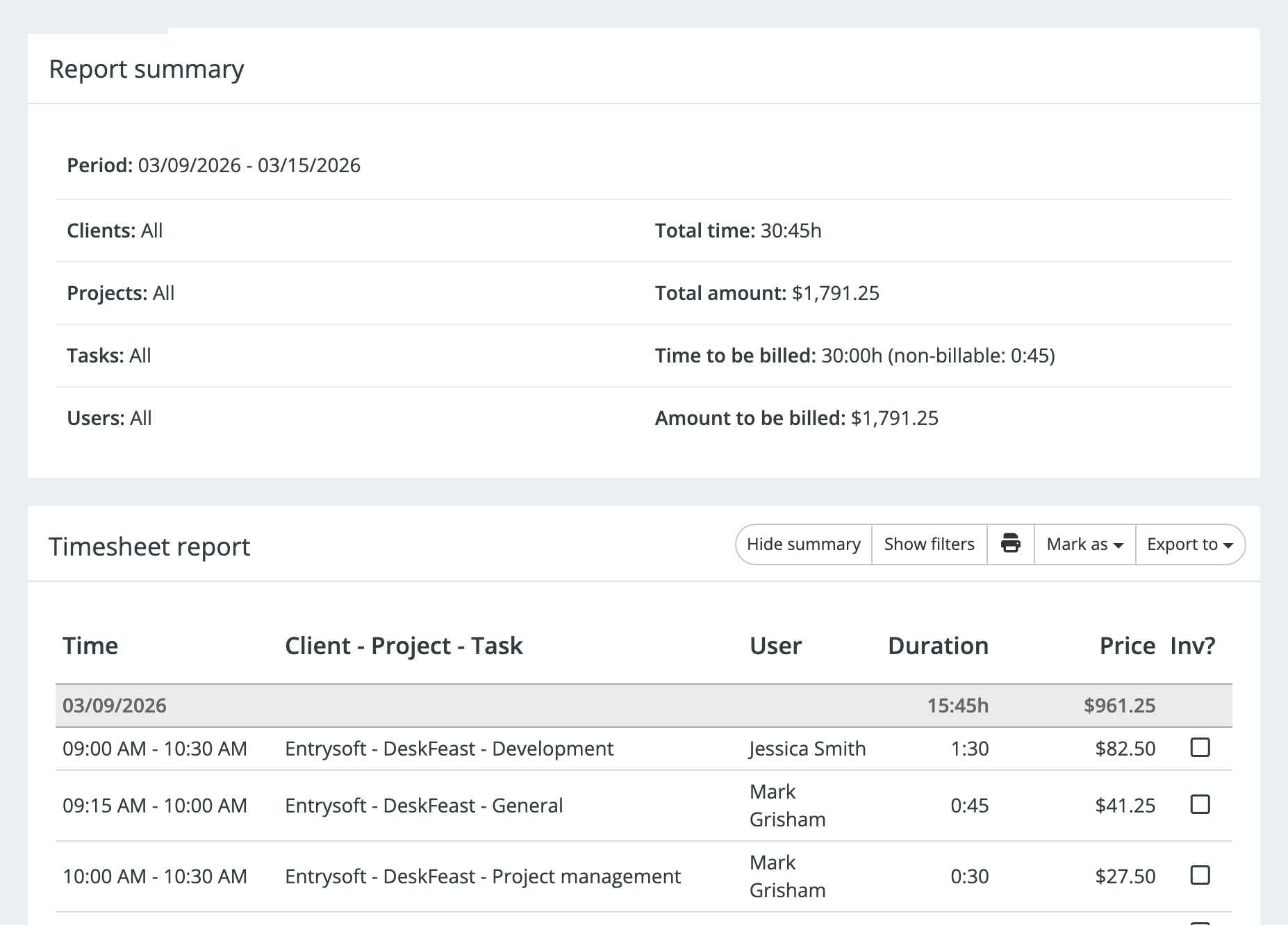
The moment labor hours are linked to the right project, task, team, and period, finance gets a much sharper picture of what is actually happening inside delivery.
That changes the conversation in at least four ways.
1. Cost accountability becomes specific
Instead of asking why a project is over budget in general, you can ask better questions. Which workstream expanded? Which role mix changed? When did non-billable support start climbing? Which client requests created extra effort without corresponding revenue?
Good time data does not just tell you that labor cost is high. It tells you where it became high.
2. Margin is monitored before invoicing
Projects often become less profitable well before the billing team sees a problem. If finance can compare planned hours, actual hours, blended cost, and realized billable output every week, margin risk stops being a surprise.
That early visibility gives you room to intervene while options still exist: re-scope, re-staff, change the billing approach, or stop spending on work that no longer supports the outcome.
3. Forecasting improves because effort patterns become real
Forecasts built on revenue history alone are often too optimistic. Forecasts built on actual delivery effort are harder to argue with. Once finance can see how similar projects consumed time by phase, role, and client profile, future project plans stop depending on wishful averages.
That is particularly valuable on large, multi-month projects where the difference between a healthy margin and a disappointing one can be hidden inside a few percentage points of extra labor.
4. ROI discussions become evidence-based
CFOs are constantly asked to fund better tooling, additional headcount, process changes, or internal improvement initiatives. Precise time data makes it easier to answer a simple question: did this investment reduce effort, accelerate delivery, improve billability, or protect margin?
If you cannot measure labor cleanly, you cannot answer that question cleanly either.
A simple example: where hidden cost tends to hide
Take a project that was sold on a healthy margin. On day one, the estimate looks reasonable.
| Metric | Planned | Actual after 10 weeks |
|---|---|---|
| Total labor hours | 1,200 | 1,340 |
| Blended labor cost per hour | EUR 68 | EUR 74 |
| Billable share of hours | 92% | 84% |
| Estimated project margin | 29% | 17% |
Nothing about that scenario is unusual. A little more senior involvement, a little more coordination time, a little more internal cleanup, and the economics of the project change materially.
Without precise timesheet data, finance sees the result late. With precise timesheet data, finance can see the slope while it is forming.
The CFO dashboard should answer these questions every Monday
For finance leaders, the value of time tracking is not in seeing every individual entry. It is in being able to answer a small number of recurring questions with confidence.
- Which projects are drifting away from their planned labor model?
- Where is senior-cost labor being used below its intended value?
- How much effort is going into work that cannot be billed or capitalized?
- Which clients or internal initiatives consume disproportionate support time?
- What are the earliest indicators that a delivery plan needs intervention?
If your current reporting cannot answer those questions until the month is closed, finance is reacting too slowly.
What recovered revenue often looks like in practice
When organizations tighten time tracking, the benefit is not only cleaner records. The financial upside tends to show up in several very practical places:
- Underbilled work is surfaced. Hours that were previously forgotten, rounded away, or parked in generic admin buckets become visible again.
- Role mix gets corrected faster. Expensive employees spending too much time on low-value tasks is easier to spot and fix.
- Client scope creep stops hiding. Additional requests can be measured and discussed based on evidence, not anecdotes.
- Forecasts become grounded in actual effort. Future projects can be priced and staffed using real labor patterns rather than optimistic assumptions.
- Low-value internal work gets challenged. Once effort is visible, recurring drains on capacity become easier to justify, redesign, or stop.
This is where recovered revenue often comes from. Not from charging more blindly, but from finally seeing what was already being spent and making better decisions earlier.
Precise does not have to mean painful
One reason finance teams hesitate to push harder on time tracking is understandable: nobody wants a system that creates friction, resentment, or fake precision.
The answer is not more bureaucracy. The answer is better design.
Teams are far more likely to keep time accurately when the process matches the way work actually happens: calendar-based entry, fast task selection, mobile access, and clear reporting back to the people doing the work. The data quality problem is often a usability problem in disguise.
That is also why the finance case should not be presented as compliance alone. Delivery leaders and project managers engage much more readily when they can see the upside for them as well: fewer surprises, better staffing conversations, cleaner client discussions, and more credible project reviews.
From timesheet data to financial intelligence
At Temponia, we have seen this pattern repeatedly. The companies that get the most value from time tracking are not the ones that obsess over timesheets for their own sake. They are the ones that treat labor data as a decision layer.
When cost rates, project structures, and hours worked are connected, finance can move beyond simple utilization reporting and start reading the business more clearly:
- project profitability by period
- margin trends over time
- real cost versus planned cost
- team effort distribution across projects and clients
- forecast inputs grounded in actual delivery behavior
That is the point where time tracking stops being an operational afterthought and starts becoming financial intelligence.
One good finance question to ask this quarter
If we had to explain our three least profitable projects in detail, could we trace the labor story clearly enough to know what to change next?
If the answer is no, the issue is probably not project complexity. It is that labor data is still too delayed, too broad, or too incomplete to support the decisions finance needs to make.
That is exactly where precise time tracking earns its place.
Not as admin overhead. Not as surveillance. But as the clearest route to better cost accountability, more credible forecasts, and stronger project ROI.
And for CFOs responsible for large project portfolios, that is usually a far better return than the price of improving the timesheet process.
Get clearer project financials
Temponia gives CFOs real-time visibility into labour costs, project margins, and budget utilisation.