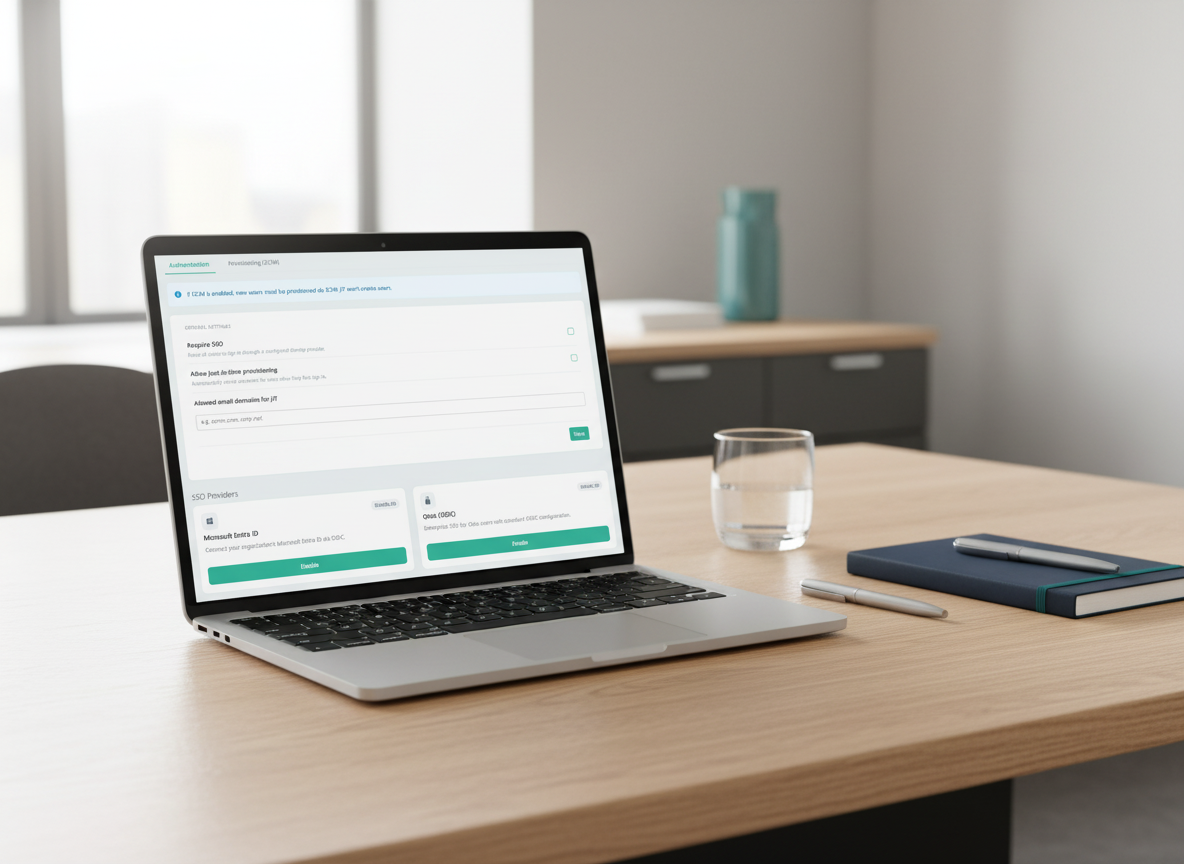
Enterprise IT teams do not evaluate a time tracking system the way a small company does.
They are not only asking whether employees can log time quickly. They are asking whether the system will fit into an identity stack, survive a security review, respect joiner-mover-leaver controls, and protect a data set that is often much more sensitive than it first appears.
That caution is justified. A modern time tracking platform does not just store hours. It stores who worked on what, when they worked, which clients were involved, which projects are profitable, where labor cost accumulates, and in many cases how that data flows into invoicing, payroll-adjacent reporting, calendar integrations, and project oversight.
Temponia sits squarely in that operational layer. It is built for structured time capture across users, clients, projects, tasks, reporting, reminders, dashboards, and downstream business processes. That makes security architecture a first-order concern, not a feature add-on.
So if you are a CTO, IT manager, or security lead reviewing time tracking software for enterprise use, this is the checklist that matters.
Why time tracking data deserves enterprise controls
Time data is often treated as harmless because it does not look like customer PII or financial ledger data. In practice, it can reveal a great deal about the organization:
- which clients are consuming support time
- which projects are overrunning budget
- which teams or individuals are working on sensitive initiatives
- which roles are generating the highest labor cost
- which internal functions are carrying hidden non-billable effort
Once timesheet data is connected to client structures, cost rates, reporting, invoicing, calendar events, or utilization dashboards, it becomes operationally sensitive. That is why enterprise buyers should evaluate a time tracking system with the same discipline they apply to other business systems of record.
1. SSO should be the baseline, not an afterthought
The first question is simple: can the platform hand authentication back to your identity provider?
For most enterprises, the answer needs to be yes. Password sprawl, inconsistent MFA enforcement, and fragmented offboarding are exactly the problems central identity exists to solve. A time tracking system should fit into that model rather than reintroducing exceptions.
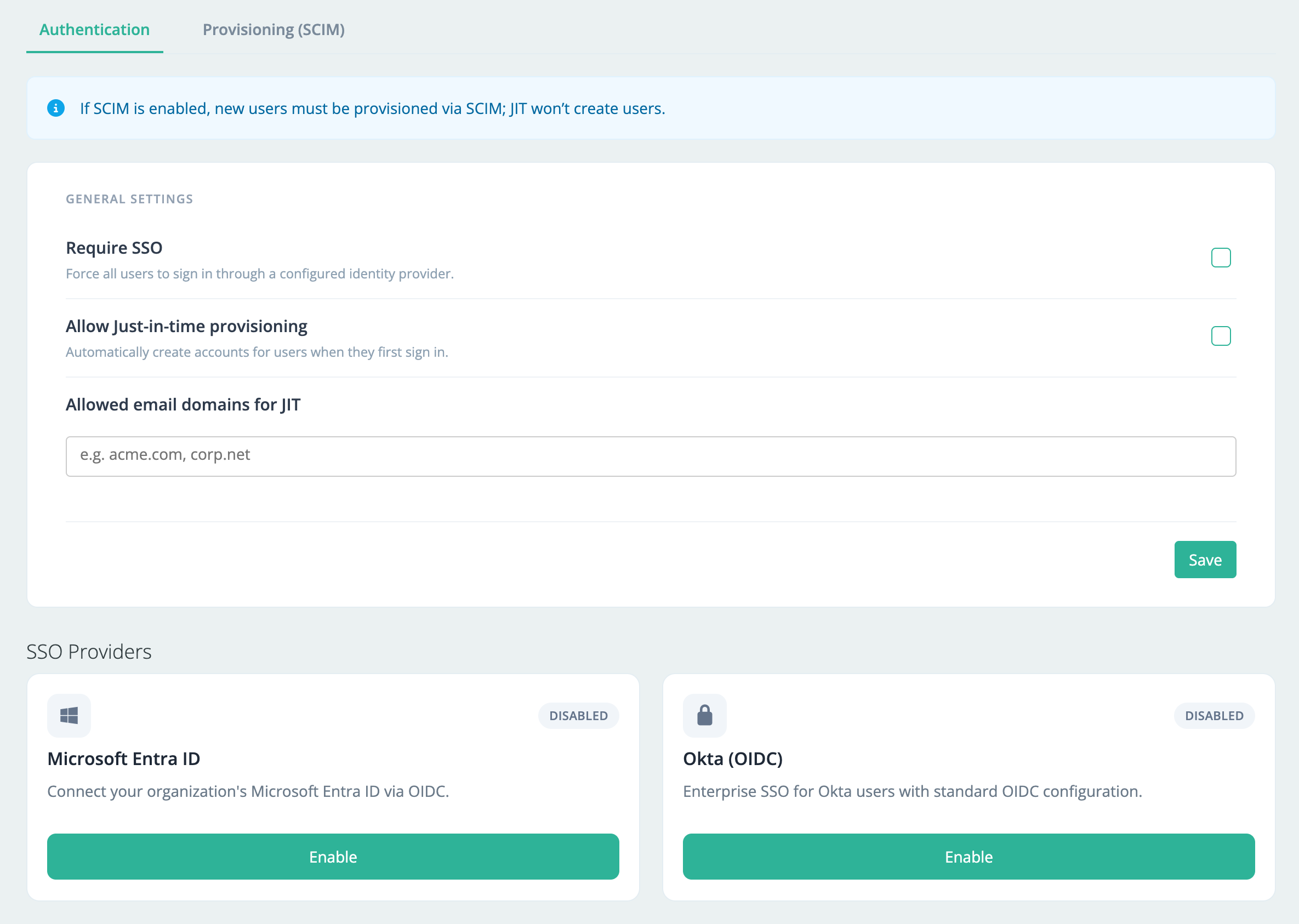
In Temponia, enterprise authentication is designed around single sign-on with supported OIDC flows for Microsoft Entra ID and Okta. That matters because it lets identity policy stay where it belongs: in the corporate IdP. Password requirements, conditional access, MFA, and sign-in governance remain centralized instead of being recreated application by application.
Just as importantly, Temponia treats SSO as a baseline security control rather than a premium afterthought. SSO is available on all tiers because we believe centralized identity is a security fundamental, not an upsell. The advanced enterprise layer is about lifecycle governance, not gatekeeping the core idea that identity should stay centralized. That is why the conversation changes at the enterprise tier from do you have SSO at all? to how do you want to govern JIT, SCIM, Entra, Okta, and deprovisioning at scale?
A good enterprise review should ask four concrete questions here:
- Can the app integrate with the identity providers we already use, especially Entra and Okta?
- Can we require SSO for the workspace instead of leaving local passwords as a parallel path?
- Is the callback and token validation model standards-based and predictable?
- Can the application participate in our existing MFA and access policy framework rather than bypassing it?
Temponia's security settings include a Require SSO control specifically for this reason. For an enterprise rollout, that kind of enforcement option matters more than simply offering an extra login button.
2. JIT provisioning is useful, but only when it is constrained
Just-in-time provisioning is one of those features that sounds either elegant or reckless depending on how it is implemented.
Used carefully, JIT can remove a lot of rollout friction. A user authenticates successfully through the corporate IdP and the account is created on first sign-in. That can be the right choice for faster deployment, pilot programs, and organizations where IdP governance is already strong and email domains are tightly controlled.
Used carelessly, JIT becomes an access expansion mechanism. If the application accepts any successful identity without the right boundaries, IT loses control over who can appear in the tenant.
That is why the real question is not whether JIT exists. It is whether JIT is governed.
Temponia approaches this with explicit controls:
- JIT can be enabled or disabled per company
- allowed email domains can be specified for JIT creation
- SSO can still be required even when JIT is in use
- when SCIM is active, JIT does not create users, so lifecycle control stays authoritative
That last point is particularly important. In enterprise environments, convenience should not outrun governance. If SCIM is the chosen provisioning authority, JIT should step aside rather than competing with it.
In enterprise SaaS, authentication convenience is helpful. Lifecycle control is mandatory.
As a rule of thumb: JIT is a sensible option when the enterprise wants fast onboarding but is still comfortable letting identity proof plus domain policy create accounts. It is not the right long-term model when access assignment, deprovisioning, and group-based entitlement all need to be centrally managed.
3. SCIM is what turns SSO from sign-in control into lifecycle control
SSO answers the question who can authenticate? SCIM answers the harder operational question who should have an account at all, and what should happen when that changes?
That distinction is why mature enterprise buyers increasingly look for both.
With SCIM, the identity platform can provision users into Temponia, update them when attributes change, synchronize groups, and deprovision them when employment or access changes. That gives IT a cleaner answer for the joiner-mover-leaver process than manual invites or loosely governed first-login creation.
Temponia's SCIM support is built around that lifecycle model:
- SCIM provisioning can be enabled separately from authentication settings
- SCIM tokens are generated explicitly and can be rotated
- users can be provisioned, updated, deactivated, and mapped to identity links
- groups can be created and updated through SCIM as part of access governance
- when SCIM is active, disabled accounts are not silently reactivated by casual sign-in paths
That is the difference between a simple SSO checkbox and something enterprise IT can actually operationalize.
It is also where Microsoft Entra ID becomes particularly relevant. In many environments, HR remains the system of record, Entra is the identity control plane, and downstream SaaS applications consume provisioning events through SCIM. Temponia fits naturally into that pattern. The same is true for Okta-centered environments, where application assignments and group-based access management are already standardized in the IdP.
4. Encryption should cover both transport and stored secrets
This is one of the least glamorous parts of a software review and one of the most important. Enterprise buyers should not settle for vague language about security here.
At minimum, a time tracking platform should protect data in transit and avoid storing operational secrets in a casually recoverable form.
In Temponia's case, that shows up in several practical places:
- TLS enforcement in production. Authentication and application traffic should run over HTTPS, especially where identity callbacks and timesheet data are involved.
- Encrypted identity provider secrets. OIDC client secrets used for Entra or Okta configuration are stored using application-level encryption rather than as plain text configuration values.
- Digest-based SCIM token handling. SCIM bearer tokens are generated once, stored as digests, and designed for rotation, reducing the exposure of long-lived provisioning credentials.
That does not magically solve every data governance question, but it does show the right posture: protect the authentication plumbing itself, not just the user-facing data.
5. Access controls should reflect how delivery organizations actually work
Enterprise security is not only about whether someone can sign in. It is also about what they can do once they are inside.
Time tracking platforms often sit between employees, project managers, finance, operations, and administrators. Those groups do not need the same level of access. A secure deployment should be able to separate day-to-day time entry from administrative control, reporting oversight, and configuration authority.
Temponia is built around role boundaries across employees, managers, admins, and owners, with permissions controlling what can be viewed or updated across timesheets, reports, settings, users, and project data. That matters because enterprise IT policies usually require the principle of least privilege to be visible in the application model, not just assumed in process documents.
For a CTO review, the practical question is this: can a normal user log time without inheriting administrative visibility into broader delivery, cost, or user-management data? If the answer is unclear, the platform is not ready for enterprise use.
6. Auditability matters once the data influences billing, reporting, or compliance
Not every enterprise needs a full forensic trail for every field in a time tracking system. But once timesheets affect client billing, project margin, internal compliance, or labor reporting, some level of auditability becomes non-negotiable.
That usually means being able to answer questions like:
- who created or changed a timesheet entry
- when a key project or task setting changed
- whether a user was disabled or removed through the identity process
- what provisioning calls were received from the SCIM endpoint
Temponia keeps auditable history on key operational records such as timesheets and related project objects, and it records SCIM events around provisioning activity. For enterprise buyers, that is not just a security benefit. It is operational insurance when finance, delivery, and IT need to reconstruct what happened.
7. Enterprise integration should reduce identity risk, not spread it around
A well-run enterprise stack usually has a clear chain of responsibility:
| Layer | Typical system of authority | What Temponia should receive |
|---|---|---|
| Employment status | HRIS or HR operations process | Identity changes propagated through the IdP |
| Authentication | Entra ID or Okta | SSO assertions via OIDC |
| Provisioning | IdP lifecycle workflows | SCIM user and group updates |
| Time capture and reporting | Temponia | Operational timesheets, projects, tasks, reporting output |
That separation is healthy. It means Temponia does not need to become the source of truth for identity just because it is responsible for time data. Instead, it can plug into the enterprise tech stack in a way that keeps identity governance centralized and downstream access predictable.
This is especially relevant when HR systems drive identity state indirectly. Many enterprises do not want every operational tool integrating directly with the HR platform. They want the HR system to feed the IdP, and the IdP to provision downstream systems consistently. That minimizes custom risk and reduces the number of places where identity logic has to be duplicated.
8. The real CTO checklist
When reviewing a time tracking platform, these are the questions worth putting on the security and architecture checklist.
| Control area | What to verify | Why it matters |
|---|---|---|
| SSO | Support for Entra ID and Okta, plus the ability to require SSO | Centralizes authentication policy, MFA, and access governance |
| JIT provisioning | Domain restrictions, explicit enablement, and clear interaction with SCIM | Prevents uncontrolled account creation |
| SCIM | User provisioning, deprovisioning, group sync, token rotation | Supports joiner-mover-leaver processes at scale |
| Secrets and tokens | Encrypted stored secrets, non-plain-text token handling, HTTPS enforcement | Protects the identity control surface itself |
| Authorization | Clear role boundaries between employees, managers, admins, and owners | Reduces unnecessary exposure to time, cost, and user data |
| Auditability | Change history and provisioning event visibility | Supports investigations, billing integrity, and compliance reviews |
| Enterprise fit | Works cleanly with the existing IdP and HR-driven identity lifecycle | Avoids one-off admin processes and brittle custom flows |
Where Temponia fits for enterprise teams
Temponia is not trying to be your identity platform, your HR system, or your compliance suite. That is exactly the point.
Its job is to provide reliable time capture, project structure, reporting, reminders, integrations, and operational visibility without forcing IT to give up centralized identity control. In an enterprise deployment, that means:
- users can authenticate through the corporate IdP instead of juggling separate credentials
- IT can choose between faster JIT onboarding and stricter SCIM-driven lifecycle control
- Entra and Okta remain the center of identity governance
- Temponia stays focused on the business layer: who logged time, where effort went, and how that affects delivery and reporting
That is the balance most enterprise teams actually want. Strong controls where controls matter. Low friction where low friction is safe. No unnecessary reinvention of the identity stack.
A final test for the buyer side
If your identity team disabled an employee at 9:00 AM, how confident are you that they would also lose access to time data, project visibility, and operational reporting without anyone doing manual cleanup?
If that question is uncomfortable, the problem is usually not the timesheet screen. It is the lifecycle model behind it.
That is why enterprise-grade time tracking security starts with SSO, gets serious with JIT guardrails, and becomes operationally trustworthy with SCIM, strong secret handling, role-based access, and auditability.
For CTOs and IT managers, that is the real checklist.
See enterprise security in action
Temponia supports SSO, SCIM provisioning, audit trails, and role-based access out of the box.